

Juan Carlos Onetti
Uruguay
Murky, self-canceling sentences that circle a fact instead of stating it: defeat narrated from so far inside it barely admits to being defeat.
Onetti left school without finishing and drifted through jobs as a doorman, salesman, and grain-company clerk in Buenos Aires and Montevideo before turning to journalism, eventually editing the Uruguayan edition of Reuters' news bulletin and, later, a cheap weekly humor magazine.
A Brief Life (1950) introduced Santa María, an invented river town he would return to for the rest of his career, its ad-man narrator escaping a dissolving marriage by dreaming up a double life inside a script for a film that will never exist. The device let Onetti fold fiction-within-fiction around his real subject: the private, unheroic defeats of people who have quietly given up.
Uruguay's 1973 military dictatorship briefly jailed him over a story-contest prize awarded to a work the junta deemed obscene; he left for Madrid on his release and never returned, dying there in 1994 after decades of increasingly reclusive, bed-bound writing.
Lines of influence
No descendants recorded, yet.
Their books in the atlas
- 1941
 No Man's LandLvl 7psychological novel
 - 1950
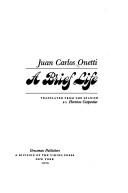 A Brief LifeLvl 8psychological novel
 - 1961
 The ShipyardLvl 8psychological novel
Meanwhile, elsewhere
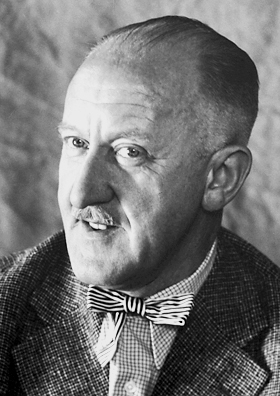 1902–1998Halldór LaxnessIcelandWestern Europe · Iceland
 1905–1994Elias CanettiBulgaria / UKWestern Europe · Bulgaria / UK
 1900–1999Nathalie SarrauteFranceWestern Europe · France
 1909–2001Eudora WeltyUnited StatesNorth America · United States1908–2000William MaxwellUnited StatesNorth America · United States
 1904–2005Ba JinChinaEast Asia · China
If you like Onetti, try
 1897–1962William FaulknerUSAshaped Onetti
 1917–1986Juan RulfoMexicoboth shaped by Faulkner · both write in Spanish · same region & era
 1928–2012Carlos FuentesMexicoboth shaped by Faulkner · both write in Spanish · same region & era
 1936–2025Mario Vargas LlosaPeruboth shaped by Faulkner · both write in Spanish · same region & era
 1911–2011Ernesto SabatoArgentinakindred genres: existentialist, psychological novel · both write in Spanish · same region & era
 1927–2014Gabriel García MárquezColombiaboth shaped by Faulkner · both write in Spanish · same region & era