
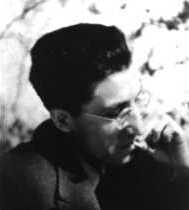
Cesare Pavese
Italy
Terse and elegiac, landscape and memory pressing against a narrator's guarded reticence: loneliness rendered in short, aching cadences.
Pavese grew up in the Piedmont hills he'd return to in every book, and made his early living translating Melville, Faulkner, and Sinclair Lewis into Italian, work that smuggled American modernism into a culture the Fascist regime wanted closed off. His anti-fascist sympathies cost him a year of internal exile in Calabria in the mid-1930s; back in Turin he joined the publisher Einaudi as an editor, working there for the rest of his life.
He spent the war in hiding rather than fighting with the partisans, a passivity that haunted him and became the buried guilt of The House on the Hill. He joined the Communist Party after the war, and won the Strega Prize in 1950 for a trio of novellas the same year The Moon and the Bonfires appeared, tracing an emigrant's failed homecoming. Weeks after the prize, undone by an unhappy love affair with the American actress Constance Dowling, he killed himself in a Turin hotel room at forty-one.
Their books in the atlas
- 1949
 The House on the HillLvl 5war novel
 - 1950
 The Moon and the BonfiresLvl 6psychological novel
Meanwhile, elsewhere
 1899–1977Vladimir NabokovRussia / USARussia & Eastern Europe · Russia / USA
 1890–1960Boris PasternakRussiaRussia & Eastern Europe · Russia
 1905–1964Vasily GrossmanUkraine / RussiaRussia & Eastern Europe · Ukraine / Russia
 1899–1951Andrei PlatonovRussiaRussia & Eastern Europe · Russia
 1870–1953Ivan BuninRussiaRussia & Eastern Europe · Russia
 1905–1984Mikhail SholokhovRussiaRussia & Eastern Europe · Russia
If you like Pavese, try
 1907–1990Alberto MoraviaItalykindred genres: psychological novel · both write in Italian · same region & era
 1867–1936Luigi PirandelloItalykindred genres: psychological novel · both write in Italian · same region & era
 1861–1928Italo SvevoItalykindred genres: psychological novel · both write in Italian · same region & era
 1943–2012Antonio TabucchiItalykindred genres: psychological novel · both write in Italian · same region & era
 1863–1938Gabriele D'AnnunzioItalykindred genres: psychological novel · both write in Italian · same region & era
 1912–1985Elsa MoranteItalykindred genres: war novel · both write in Italian · same region & era