
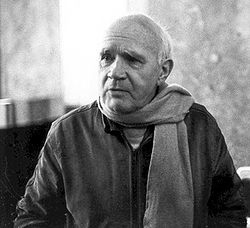
Jean Genet
France
Baroque, incantatory sentences that dress criminality in the language of sainthood, transfiguring squalor into deliberate, sacrilegious beauty.
Genet was abandoned by his mother as an infant, raised by the state welfare agency and a foster family in rural France, and began a life of petty theft, vagrancy, and male prostitution across Europe as a teenager, drifting in and out of reformatories and prisons for two decades. He wrote Our Lady of the Flowers in Fresnes prison in the early 1940s, reportedly on paper intended for the workshop's paper bags.
Facing a possible life sentence under France's habitual-offender laws, he was saved by a campaign led by Jean-Paul Sartre and Jean Cocteau, who championed his manuscripts and secured a presidential pardon; Sartre's book-length study Saint Genet made him a literary cause célèbre. He largely abandoned fiction after the 1940s for theater and, later, political activism (supporting the Black Panthers and the Palestinian cause) until his death in 1986.
Their books in the atlas
- 1943
 Our Lady of the FlowersLvl 8psychological novel
 - 1949
 The Thief's JournalLvl 7autobiographical fiction
Meanwhile, elsewhere
 1900–1989Sándor MáraiHungaryRussia & Eastern Europe · Hungary
 1909–2001Eudora WeltyUnited StatesNorth America · United States
 1905–1989Robert Penn WarrenUnited StatesNorth America · United States
 1909–1993Wallace StegnerUnited StatesNorth America · United States1908–2000William MaxwellUnited StatesNorth America · United States
 1902–1991Isaac Bashevis SingerPoland / United StatesNorth America · Poland / United States
If you like Genet, try
 1900–1999Nathalie SarrauteFrancekindred genres: psychological novel · both write in French · same region & era
 1908–1986Simone de BeauvoirFrancekindred genres: psychological novel · both write in French · same region & era
 1888–1948Georges BernanosFrancekindred genres: psychological novel · both write in French · same region & era
 1917–1976Tove DitlevsenDenmarkkindred genres: autobiographical fiction, psychological novel · same region & era
 1885–1970François MauriacFrancekindred genres: psychological novel · both write in French · same region & era
 1914–1996Marguerite DurasFrance / Vietnamkindred genres: autobiographical fiction, psychological novel · both write in French · same region & era