

Yasunari Kawabata
Japan
Elliptical and hushed, built from imagery rather than explanation: feeling arrives sideways, in a gesture or a patch of snow, never stated outright.
Orphaned of both parents by age three and then of the grandfather who raised him at fifteen, Kawabata grew up so surrounded by death that classmates called him a 'master of funerals.' He studied at Tokyo Imperial University and joined the Shinkankakuha, a group of young writers chasing new sensory techniques for Japanese prose.
Snow Country, revised and expanded over more than a decade, distilled a doomed love affair at a hot-spring inn into prose as spare as haiku; The Sound of the Mountain later did the same for an old man's misplaced tenderness toward his daughter-in-law. In 1968 he became the first Japanese writer awarded the Nobel Prize in Literature.
He had mentored and championed the young Yukio Mishima for two decades; Mishima's ritual suicide in 1970 devastated him. Kawabata died by gas asphyxiation in 1972, leaving no note.
Lines of influence
No ancestors recorded: a headwater.
Their books in the atlas
- 1947
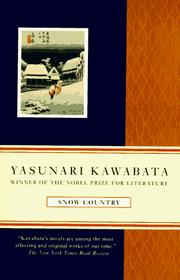 Snow CountryLvl 5psychological novel
 - 1952
 Thousand CranesLvl 5psychological novel
 - 1954
 The Sound of the MountainLvl 5psychological novel
 - 1954
 The Master of GoLvl 5psychological novel
 - 1965
 Beauty and SadnessLvl 6psychological novel
Meanwhile, elsewhere
 1890–1979Jean RhysUnited Kingdom / DominicaWestern Europe · United Kingdom / Dominica
 1891–1974Pär LagerkvistSwedenWestern Europe · Sweden
 1899–1977Vladimir NabokovRussia / USARussia & Eastern Europe · Russia / USA
 1892–1975Ivo AndrićYugoslavia / BosniaRussia & Eastern Europe · Yugoslavia / Bosnia
 1893–1977Miloš CrnjanskiSerbiaRussia & Eastern Europe · Serbia
 1892–1982Djuna BarnesUnited StatesNorth America · United States
If you like Kawabata, try
 1925–1970Yukio MishimaJapanshaped by Kawabata · kindred genres: psychological novel, tragedy · both write in Japanese
 1886–1965Jun'ichirō TanizakiJapanshared movement: Japanese Modernism & Aesthetics · kindred genres: psychological novel, family saga · both write in Japanese
 1867–1916Natsume SōsekiJapanshared movement: Japanese Modernism & Aesthetics · kindred genres: psychological novel · both write in Japanese
 1892–1927Ryūnosuke AkutagawaJapanshared movement: Japanese Modernism & Aesthetics · kindred genres: psychological novel · both write in Japanese
 1909–1948Osamu DazaiJapankindred genres: psychological novel, family saga · both write in Japanese · neighboring movements
 1862–1922Ōgai MoriJapanshared movement: Japanese Modernism & Aesthetics · kindred genres: psychological novel, tragedy · both write in Japanese