
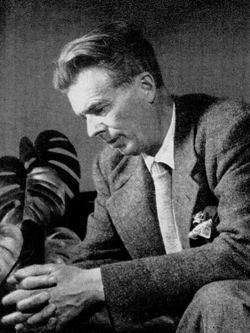
Aldous Huxley
England
Cool, essayistic irony wrapped around a genuinely disturbing premise: ideas dramatized with the same crisp wit he'd have used for a drawing-room satire.
Huxley lost most of his sight to a teenage illness, ending his ambition to become a doctor like his grandfather Thomas Henry Huxley and pushing him toward literature instead. At Oxford and after, he wrote glittering satires of Bright Young Things (Crome Yellow, Point Counter Point) skewering the intellectual fashions of 1920s England.
Brave New World (1932) turned that satirical eye forward: a World State that engineers babies by caste, drugs unhappiness away with soma, and keeps its citizens content rather than obedient: a rebuke to the era's cheerful faith in scientific utopia.
He moved to California in 1937, drifted into mysticism and psychedelic experiment, and wrote The Doors of Perception after taking mescaline. He died on November 22, 1963, requesting an injection of LSD on his deathbed, the news swallowed by the assassination of John F. Kennedy that same afternoon.
Their books in the atlas
- 1928
 Point Counter PointLvl 6satire
 - 1932
 Brave New WorldLvl 4dystopian
 - 1936
 Eyeless in GazaLvl 7bildungsroman
 - 1962
 IslandLvl 5speculative fiction
Meanwhile, elsewhere
 1892–1975Ivo AndrićYugoslavia / BosniaRussia & Eastern Europe · Yugoslavia / Bosnia
 1893–1977Miloš CrnjanskiSerbiaRussia & Eastern Europe · Serbia
 1891–1964Nella LarsenUSANorth America · USA
 1892–1982Djuna BarnesUnited StatesNorth America · United States
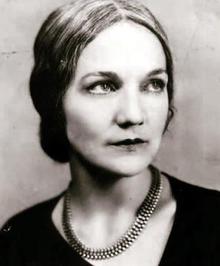 1890–1980Katherine Anne PorterUnited StatesNorth America · United States
 1878–1968Upton SinclairUnited StatesNorth America · United States
If you like Huxley, try
 1903–1950George OrwellEnglandshared movement: The British Midcentury Novel · kindred genres: satire, dystopian · same region & era
 1917–1993Anthony BurgessEnglandshared movement: The British Midcentury Novel · kindred genres: satire, dystopian · same region & era
 1918–2006Muriel SparkScotlandshared movement: The British Midcentury Novel · kindred genres: satire, bildungsroman · same region & era
 1929–2018Ursula K. Le GuinUnited Statesshared movement: Literary Speculation · kindred genres: speculative fiction, bildungsroman
 1882–1941Virginia WoolfEnglandkindred genres: modernist, satire · neighboring movements · same region & era
 1877–1962Hermann HesseGermany / Switzerlandkindred genres: bildungsroman, philosophical novel · neighboring movements · same region & era